Announcements
Fundamentals of the Pomodoro technique
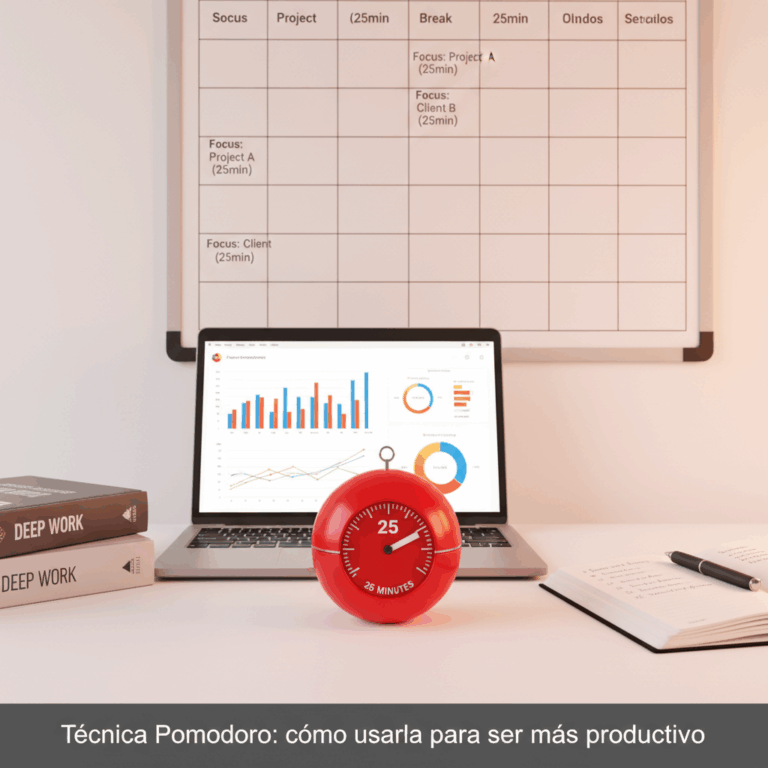
The pomodoro technique it is an effective method of time management that improves productivity through short work intervals. These are called épomodoros arten and last 25 minutes.
It was developed by Francesco Cirillo in the 80s with the purpose of optimizing its concentration during the study. Since then, it has become popular in different areas to organize attention and avoid distractions.
The method combines periods of intense focus with short breaks, facilitating a balance between mental activity and recovery, reducing fatigue and maintaining motivation.
Origin and creation of the technique
The Pomodoro technique was created by Francesco Cirillo in the 1980s while he was trying to improve his concentration by studying. He used a tomato-shaped kitchen timer, hence its name.
Announcements
This method was based on dividing work into small time intervals, allowing better management of attention and avoiding procrastination. Its simplicity and effectiveness quickly made it popular.
Since then, many people and professionals have adopted this system to improve their work and academic performance, adapting it to their own needs.
Basic principles of the Pomodoro method
The method is supported by five simple steps: choose a task, set a 25-minute timer, work without interruptions, take a short pause and repeat the process.
Announcements
After four consecutive pomodoros, a longer break of 15 to 30 minutes is recommended to regain energy and maintain concentration for future sessions.
This cycle promotes intense focus while minimizing mental exhaustion, allowing better control over time and greater efficiency in the tasks performed.
Practical implementation in your routine
To start using the Pomodoro technique in your daily life, it is essential to follow a series of steps that guarantee its effectiveness. This simple structure allows you to organize time optimally.
The method seeks to encourage focus by dividing work into specific intervals, which helps maintain concentration and avoid frequent distractions during activities.
The implementation easily adapts to different activities, facilitating a significant increase in productivity both in studies and in work or personal tasks.
Steps to apply the technique
First, select the task you want to perform and set a timer for 25 minutes. During this time, work concentrated without interruptions until the timer ends.
At the end of the pomodoro, mark the completed task and take a short five-minute break to recover and clear your mind before continuing.
Repeat this process four times and then take a longer pause, 15 to 30 minutes, to fully recover and improve your subsequent performance.
Duration of intervals and pauses
The basis of the technique consists of working 25 minutes in a row, called pomodoros, which allows an intense period of concentration without external distractions.
After each pomodoro, a short 5-minute break is recommended to avoid mental fatigue and keep the energy level stable throughout the day.
After completing four consecutive pomodoros, it is vital to take a long pause that varies between 15 and 30 minutes for the brain to recharge properly.
Examples of daily application
A student can use the technique to divide reading a book into manageable segments, ensuring that each 25-minute session is productive and focused.
At work, a professional could group small tasks like answering emails and calls into a single pomodoro to optimize time.
Even in domestic tasks, such as cleaning or organizing, applying the technique helps maintain discipline and avoid procrastination, achieving daily goals.
Tips to maximize productivity
Maximizing productivity with the Pomodoro technique requires organizing and managing work intelligently. This involves dividing long tasks and grouping similar activities.
Additionally, controlling interruptions and maintaining focus during knobs is essential to get the most out of each work interval. These strategies enhance your performance.
Split and group tasks efficiently
To apply the technique correctly, it is essential split large tasks in smaller, more manageable parts that can be completed in several pomodoros.
Additionally, grouping similar small tasks into a single pomodoro avoids distractions and improves efficiency by reducing time wasted on context changes.
This method allows you to plan the time necessary for each activity, making it easier to control progress and adjusting the workload according to your capabilities.
Interruption and focus management
During each pomodoro, it is key to minimize any type of interruption to maintain a state of deep concentration. Turning off notifications and letting others know can help.
If an interruption arises, the ideal is to write down the distraction to address it later, without breaking the current work cycle, thus preserving rhythm and motivation.
Proper focus management allows you to perform tasks with higher quality and in less time, taking advantage of the structure of the method to keep the brain fresh and active.
Benefits and adaptability
The Pomodoro technique offers multiple benefits that improve concentration and organization, helping to manage time efficiently. Its structure makes it easy to maintain focus on specific tasks.
Additionally, this methodology promotes a balance between periods of intense work and short breaks, which reduces mental exhaustion and improves the ability to maintain attention.
Its flexibility makes it suitable for adapting to different contexts, from study and work to daily activities, enhancing productivity in any area.
Advantages over concentration and organization
Using 25-minute knobs, the technique encourages deep focus, allowing you to advance efficiently on tasks without distractions. This significantly improves concentration.
Short breaks help avoid mental fatigue, allowing you to maintain a constant pace of work throughout the day, optimizing your ability to maintain order and planning.
By dividing work into manageable segments, you make it easier to prioritize and organize activities, contributing to better time distribution and greater control over pending tasks.
Adaptation to study, work and daily life
In the study, the technique helps segment content into digestible parts, promoting more effective and less exhausting learning sessions, ideal for students of all ages.
For work, it allows you to manage complex projects by dividing them into manageable activities, increasing productivity and reducing procrastination in work environments.
In daily life, it is applied to organize daily tasks, from home to personal activities, facilitating a better balance between responsibilities and time for rest.